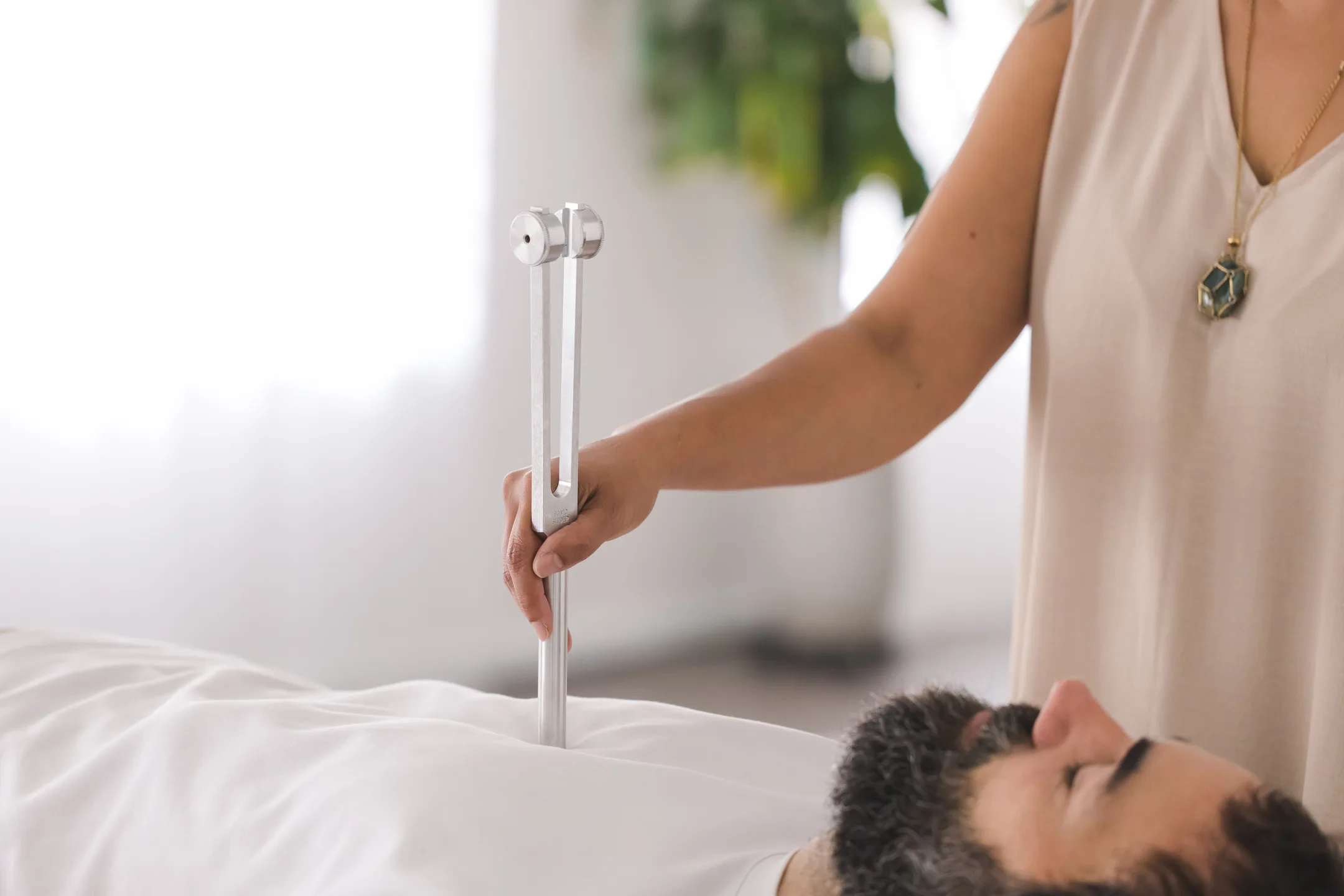
What tuning fork healing is.
A tuning fork is a precision instrument. Struck against a surface, it produces a sustained, calibrated tone at a specific frequency.
When that vibration is brought to or on the body, it becomes both audible and physical — a pressure wave the nervous system responds to before conscious thought engages.
The therapeutic use of tuning forks isn't new. Forks have been used in medical examination since the 19th century — the Weber and Rinne tests for hearing, taught in audiology programs to this day, both rely on a tuning fork held against bone.
The shift from diagnostic use to therapeutic use unfolded across the 20th century, and certified practitioner systems formalised in the 1990s and 2000s — Acutonics, Biofield Tuning, Ohm Therapeutics, and others.
What's commonly called "tuning fork healing" today spans a wide spectrum of practice. From self-application with affordable forks at home, to weekend workshops within a wellness-practitioner framework, to multi-year certified clinical training. All three are real tuning fork practice. The depth and precision differ markedly.
How tuning forks work in the body.
Sound is physical. A tuning fork produces a pressure wave that moves through air, then through tissue, then through the field around the body.
At certain frequencies, that wave engages the autonomic nervous system before the cognitive mind has named it. Breathing slows. Muscle tension shifts. Heart rate variability adjusts.
This is biofeedback through resonance. The nervous system responds to sustained tonal input by changing state — vagal tone, breathing rhythm, the quality of attention. Research on the underlying mechanisms (Polyvagal theory, work from the HeartMath Institute, peer-reviewed studies of music therapy and acoustic stimulation) increasingly supports what practitioners have observed in sessions for decades.
What changes between self-practice and certified work isn't the tool. It's what you can hear.
Where the work gets interesting is in what a trained practitioner can hear. Sound carries information.
As a tuning fork moves through the field around the body, the tone changes — clear and ringing where the field is coherent, distorted or resistant where energy is held. A trained practitioner reads these shifts in real time, using them to locate areas of tension, and what's often held within them: memories, emotional residue, subconscious patterns that the body has been quietly organising around.
This is where the work becomes more than relaxation. The practitioner isn't simply introducing frequency — they're listening. And what they hear directs the session. This is the line where tuning fork practice moves from generalised support into directive work.
The spectrum of practice.
Tuning fork healing today exists as a wide spectrum. The honest map of what's possible at each level matters more than picking a side.
Self-practice at home.
Affordable tuning fork sets are widely available — typically a weighted fork for body application paired with one or more unweighted forks for ambient use. At-home practice can support general nervous system regulation, settle the parasympathetic state before sleep, and offer a tactile point of focus during stress.
The limits are real too: self-practice can't locate patterns specific to your field, can't work at clinical depth, and can't substitute for the trained observation a certified practitioner brings. Real, with a clear ceiling.
Workshops and short-form training.
One-to-three-day trainings teach basic fork application within a wellness-practitioner framework — yoga teachers, massage therapists, breathwork facilitators adding tuning forks to their existing toolkit.
This level supports practice extension and personal development. It doesn't produce a standalone clinical practice; the depth of training isn't there to support that, and the credentialed systems are clear about it.
Certified practitioner systems.
The certified end of the spectrum runs through multi-year training programs — Eileen McKusick's Biofield Tuning, Donna Carey's Acutonics, Ohm Therapeutics, others.
These programs develop the trained ear, the practical framework, and the understanding of when and how to apply specific frequencies for specific purposes. Tuning fork work at this level becomes a primary practice — directive, calibrated, built across a series of sessions rather than offered as a single experience.
Each level is real. The right one depends on what you're after — and how deep you want to go.
Where Vanessa fits
The certified practitioner end.
Vanessa Fernandez is a certified Biofield Tuning practitioner trained in the Eileen McKusick method — the most established certified system within the tuning fork tradition. She works primarily at the 1:1 therapeutic end of the spectrum, using calibrated tuning forks to locate and release pockets of tension in the body's electromagnetic field.
In a session, the work is built around your specific intention — what your field is actively holding, and what's seeking release. The forks become a way of locating it, listening to it, and creating the conditions for it to move. Sessions are directive and personal, not ambient or one-size-fits-all.
The work is precise, not performed. Years of training to listen for what changes when the tone meets resistance. This is what tuning fork practice becomes when it's a primary modality rather than an addition.
For the full picture of what Biofield Tuning is, how a session unfolds, and the research grounding the practice, see the modality page.
In a session
What working with a practitioner looks like.
In-person sessions are held at Onespace Collective in Mona Vale, on Sydney's Northern Beaches. Online sessions are available globally — the field is readable at a distance, and clients consistently report shifts comparable to coming into the room. Sessions run 60 to 90 minutes.
A first session begins with a brief intake — what's bringing you in, what you're hoping to move. You lie down clothed; nothing is asked of you except to receive. Vanessa works with the forks across the field around your body, listening for where the tone changes, locating what's held, supporting release.
After a session, integration unfolds over hours and days. Sleep is often deeper. The nervous system is noticeably steadier.
Many feel a meaningful shift after one session; three to five sessions, spaced one to two weeks apart, supports lasting change.
For full session detail and pricing, see Biofield Tuning and Sessions.
What the research is showing.
The research base for tuning fork therapy specifically is still emerging, but the underlying mechanisms are increasingly well-supported.
Peer-reviewed work on heart rate variability, vagal tone, and the nervous system's response to acoustic frequency points to real physiological pathways for what practitioners have observed in sessions.
The science isn't yet able to validate every claim made in the broader tuning fork space — but the core mechanism (sound → nervous system response → measurable physiological shifts) is no longer in serious doubt.
A starting point
- HeartMath Institute — research on heart-brain coherence and acoustic resonance. Visit HeartMath
- Stephen Porges — Polyvagal Theory — the science of nervous system safety and vagal tone. Visit Stephen Porges
- Frontiers in Psychology — peer-reviewed work on sound, music therapy, and nervous system regulation. Visit Frontiers
Tuning fork healing, including Biofield Tuning, is a complementary practice. It is not a medical treatment and makes no medical claims.