What sound healing is.
Sound healing is a broad category of therapeutic practice that uses vibration and acoustic resonance to influence the body and nervous system. Sound is physical — a pressure wave moving through air, then through tissue, then through the field around the body.
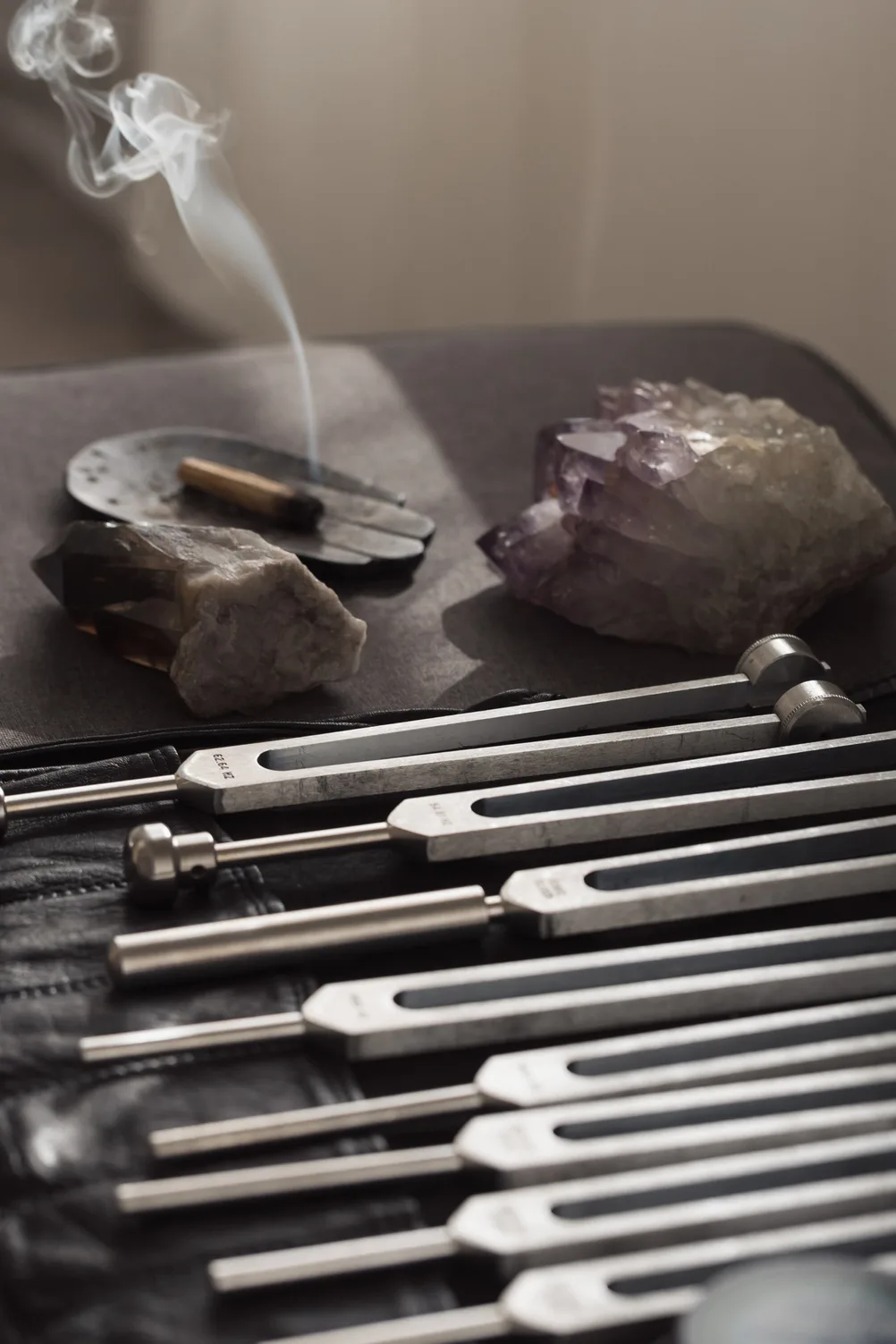
The work draws on traditions that long predate the modern label: Tibetan singing bowls, Aboriginal didgeridoo, indigenous chant and drumming, the use of tuning forks in Western therapeutic settings since the early 20th century.
What's distinctive about sound is how quickly it bypasses cognition. Before language processes a tone, the autonomic nervous system has already responded — breath shifts, muscle tension changes, heart rate variability adjusts. This is why certain sounds soothe before you know why, and why sound can be used as a therapeutic tool at a level deeper than conscious thought.
Sound reaches the nervous system before language does.
In practice, sound healing today spans a spectrum — from immersive group experiences (sound baths, gong baths, retreats) at one end, to targeted 1:1 work (biofield tuning, sound therapy with calibrated forks) at the other.
Both ends are real sound healing. They do different things — and the right one depends on what you're looking for.
What's available locally.
Sydney has built a serious sound healing community over the last decade — driven partly by the city's wellness culture, partly by a post-pandemic appetite for embodied practice, partly by a generation of practitioners trained in increasingly specific modalities. The result is a small but mature scene with clear ends to its spectrum.
At the collective end, sound baths and gong baths are the most familiar format — group experiences in dedicated studios or wellness venues, often led by one or more practitioners working with bowls, gongs, didgeridoos, and voice. The work is immersive, ambient, and trades on the compounded energy of a shared room.
Sessions can be deeply moving — the strength of the collective field is real, and many find the format opens something that 1:1 work cannot reach in the same way.
At the personalised end, 1:1 practitioner-led work uses calibrated tuning forks to address what's specifically yours. Biofield Tuning, sound therapy, and tuning fork therapy all sit here — directive, intentional, built around your field rather than the room's.
Sessions can be very gentle — often closer to what newcomers imagine a sound bath will be — but they can also go to depths that group work, by design, doesn't pursue.
Local venues like Onespace Collective in Mona Vale anchor one end of this community, hosting both group experiences and 1:1 practitioners under one roof. It's a small ecosystem, but a serious one.
Both ends of the spectrum are real sound healing. They do different things — and the right one depends on what you're looking for, not on which is deeper or better.
Where 1:1 work sits
The 1:1 end of the spectrum.
Vanessa Fernandez is a certified Biofield Tuning practitioner trained in the Eileen McKusick method — the originating tradition of the modality. Her 1:1 sessions sit at the personalised end of Sydney's sound healing spectrum, working with calibrated tuning forks to locate and release pockets of tension in the body's biofield.
In a session, the work is built around your specific intention — what your field is actively holding, and what's seeking release. The forks become a way of locating it, working with it, and creating the conditions for it to move. The work is directive, not ambient — a different conversation with sound than a group experience offers.
Vanessa also works in group settings through Stellar Sound and other collaborations — her particular gift there is reading both the room's collective tension and individual participants in the field, tailoring the work to both at once. It's the same listening, scaled.
Both have value; they serve different needs. For group sound work in Sydney — sound journeys, gong baths, retreats — see Stellar Sound (Vanessa is a co-founder).
What a 1:1 session involves.
In-person sessions are held at Onespace Collective in Mona Vale — a quiet, light room prepared for wellbeing work, with a treatment table and the forks and not much else. Online sessions follow the same structure remotely.
Sessions begin with a brief intake — what's bringing you in, what you're hoping to move, anything you'd like the session to attend to. You lie down clothed; nothing is asked of you except to receive.
The forks are activated and brought into the field around or on your body — biofeedback through resonance: where the field is coherent, the tone rings clear; where energy is held, the tone changes.
You may see colours, feel tingling along the body, a wave-like quality moving through, or sometimes a sudden surfacing of an emotion or memory you didn't know you were carrying.
Most clients describe an unusually deep, almost trance-like relaxation — quieter than meditation, less effortful than yoga, more directed than a sound bath. None of it requires belief; the work happens through resonance, not concept.
After a session, integration unfolds over hours and days — sleep is often deeper, the nervous system noticeably steadier. Many feel a meaningful shift after one session; three to five sessions, spaced one to two weeks apart, supports lasting change.
See sessions and pricingChoose what fits you.
Both ends of the spectrum are real options. The choice isn't about depth or quality — it's about what you're actually after.
1:1 biofield tuning suits you if:
- You want work that's tailored to your specific intention
- You want prolonged, singular attention in a fully held container
- You're working on a specific pattern — recurring tension, an emotional pattern, nervous system dysregulation
- You want a structured arc across 3–5 sessions
- Group settings sometimes feel a little exposed for you
Group sound work suits you if:
- You want the compounded energy and collective field of a shared room
- You enjoy immersive, ambient experience over directive work
- You want to be held by a larger container — sometimes with multiple facilitators present
- You're drawn to the depth that group resonance can produce
- You'd rather sink in alongside others than be the focus of the work
What the research is showing.
The research base for sound therapy is still emerging, but the underlying mechanisms are increasingly well-supported. Peer-reviewed work on heart rate variability, vagal tone, and the nervous system's response to acoustic stimulation points to real physiological pathways for what practitioners have long observed in sessions.
The science isn't yet able to validate every claim made in the broader sound healing space — but the core mechanism (sound → nervous system response → measurable physiological shifts) is no longer in serious doubt.
A starting point, not an exhaustive map:
- HeartMath Institute — research on heart-brain coherence and acoustic resonance
- Stephen Porges — Polyvagal Theory — the science of nervous system safety and vagal tone
- Frontiers in Psychology — peer-reviewed work on sound, music therapy, and nervous system regulation
A note on evidence. Sound healing, including biofield tuning, is a complementary practice. It supports wellbeing and regulation — it does not diagnose, treat, or cure medical conditions. Vanessa always recommends continuing any current medical treatment and consulting your GP for health concerns.