What Biofield Tuning is.
Biofield Tuning is a sound therapy method developed by Eileen McKusick that uses calibrated tuning forks to work with the body's electromagnetic field.
The biofield is the body's electromagnetic field — the measurable current that runs through the nervous system, the magnetic field generated by the heart, and the subtle energetic field that surrounds and permeates the body. It's not a mystical concept.
The term was formally adopted by the US National Institutes of Health in 1992. Research tools like the electrocardiogram and magnetoencephalogram have confirmed that the body generates measurable electrical and magnetic fields — the broader mapping of the biofield builds on this foundation.
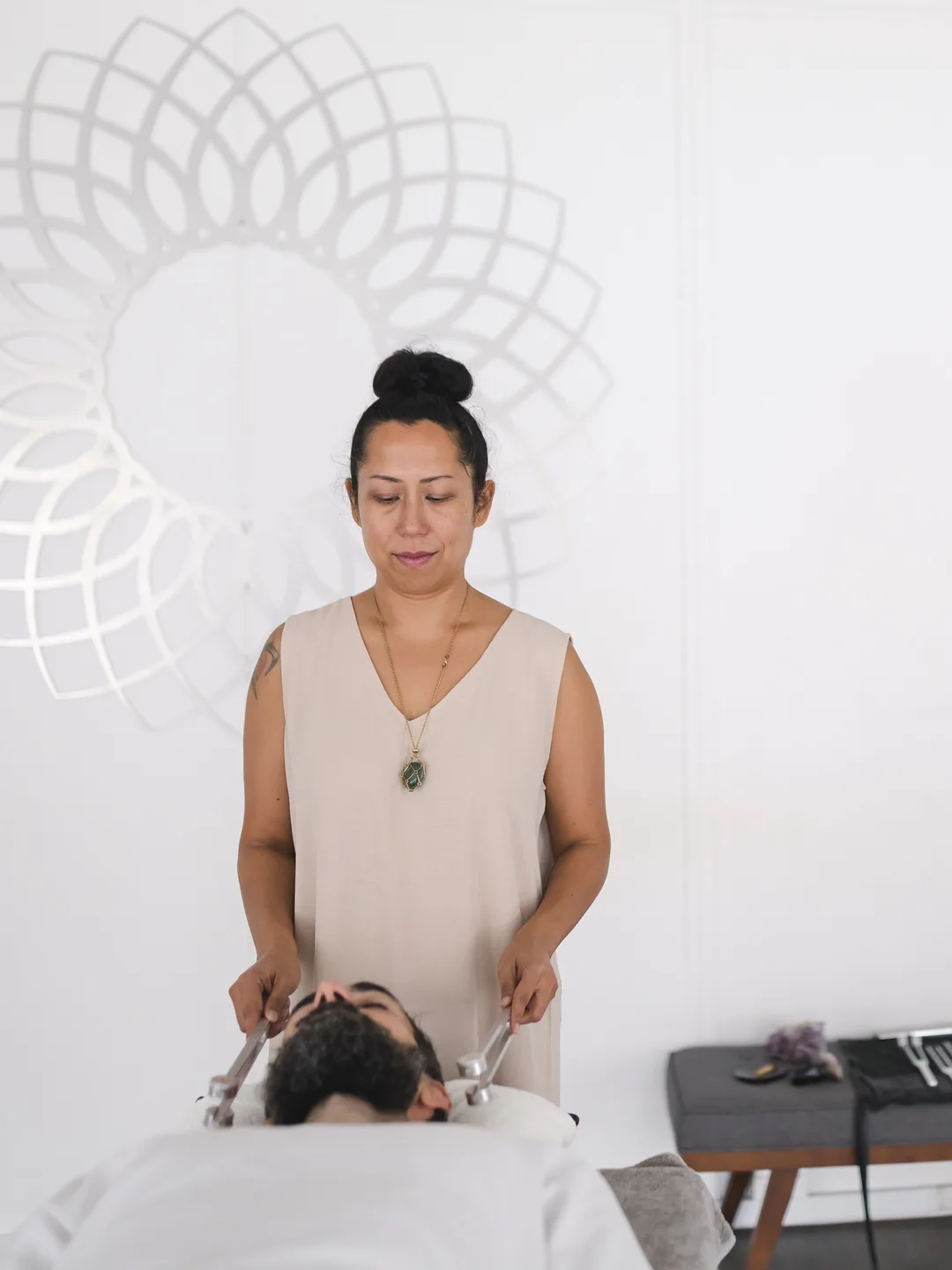
Biofield Tuning works directly with the body and our electromagnetic field. A trained practitioner activates weighted tuning forks — tuned to specific frequencies — and brings them into the field surrounding the body or directly on the body.
Where the field is coherent, the tone rings clear. Where energy is held — a stored pattern, a compression in the field, a knot of unresolved charge — the tone changes.
It warbles, flattens, or distorts. These tonal changes can be heard and also felt by the practitioner holding the tuning fork.
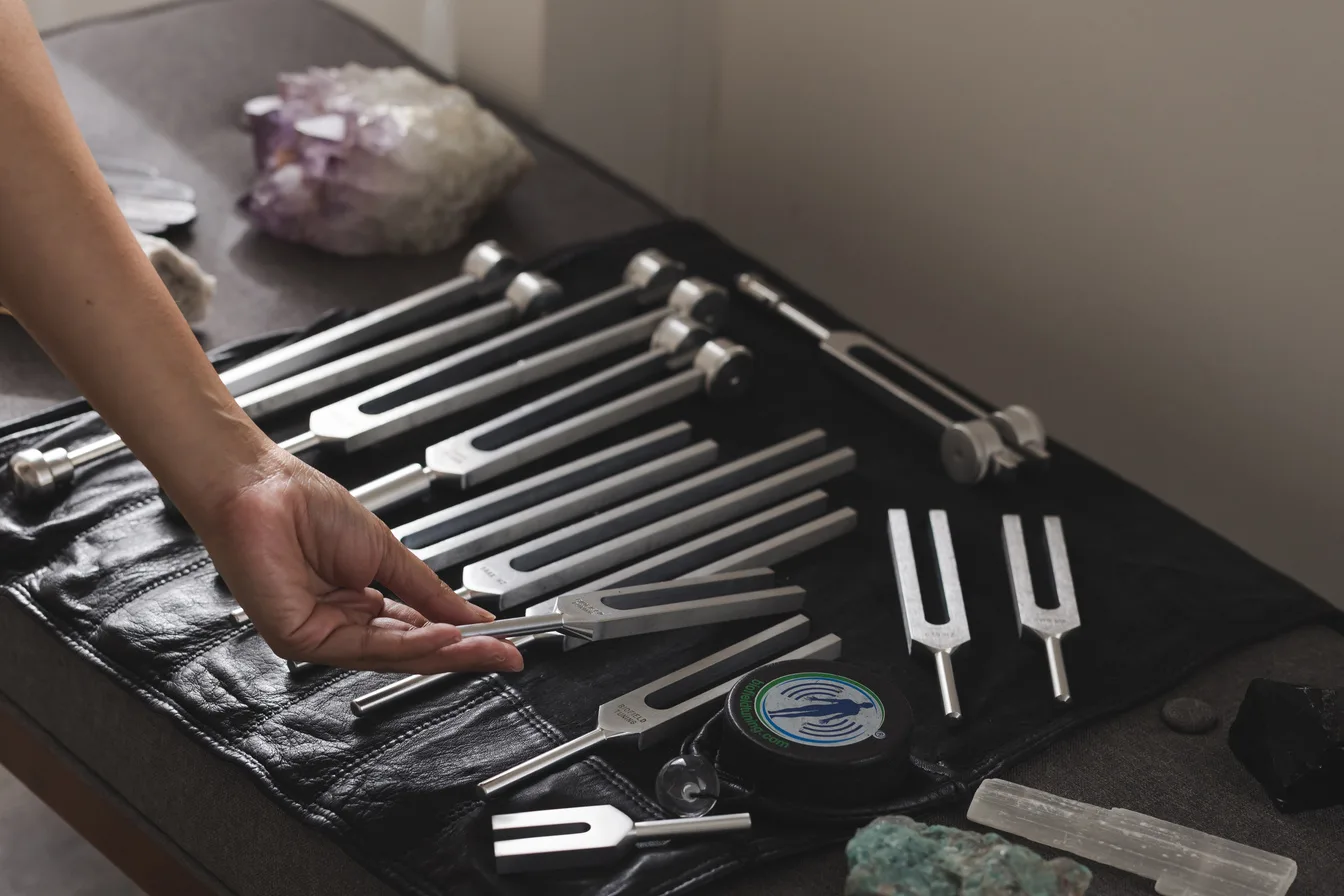
The practitioner uses this biofeedback through resonance to locate specific areas of incoherence, and then holds the fork at that location. The sustained, coherent tone encourages the field to entrain — to match the fork's resonance — and in doing so, the held pattern begins to release.
This isn't metaphor. It's mechanical. Sound is vibration, and the body is a system that vibrates back.
Every cell in your body has a natural resonance. Every organ has a frequency range. Your heart produces a magnetic field strong enough to be detected several feet from the body.
The therapeutic application of specific frequencies to this system is the foundation of Biofield Tuning.
Sound doesn't begin in your ears. It begins as movement. A pressure wave moving through space — and then, through you.
The science behind it.
Biofield Tuning sits within an emerging scientific conversation about the body's electromagnetic nature — one that's increasingly supported by research into sound, vibration, and nervous system regulation.
The body is electromagnetic
Every heartbeat generates an electrical signal strong enough to be measured several feet from the body. Every thought, sensation, and emotion produces measurable changes in the nervous system's electrical activity.
The HeartMath Institute has documented that the heart's magnetic field is approximately 100 times stronger than the brain's, and extends well beyond the skin.
This isn't controversial science. It's the foundation of modern diagnostic medicine — the ECG, the EEG, the MRI — all of which rely on detecting and measuring the body's electromagnetic activity. Biofield Tuning extends this recognition of the body's electromagnetic nature into a therapeutic application.
Why sound works
The body is mostly water — approximately 60 to 70 percent by mass, held within fascia and cellular structure. Water transmits vibration efficiently. This is why sound doesn't just reach your ears; it reaches your body.
It's felt through the fluids, through the fascia, through the resonant cavities of the chest, abdomen, and skull. Different frequencies reach different tissues, organs, and systems.
Key insight
Before language processes a sound, the nervous system has already responded to it. Your breath changes. Your muscles respond. Your heart rate shifts. This is why certain sounds can soothe you before you know why — and why sound can be used as a therapeutic tool at a level deeper than conscious thought.
Nervous system regulation and the vagus nerve
Established nervous system research has shown that the vagus nerve plays a central role in how the body moves between states of activation and rest. Low-frequency sound, breath-based practices, and specific tonal patterns can all stimulate vagal tone, shifting the system toward parasympathetic regulation — the state where healing, repair, and integration happen.
This is consistent with what clients experience during a Biofield Tuning session: a progressive deepening into a relaxed, almost trance-like state. And when the nervous system feels safe enough, it stops holding.
How a session works.
Sessions are quiet, directive, and non-invasive. You remain clothed. The forks are never used near sensitive areas. The structure is consistent, and each session builds on the last.
Before the session
A short intake form is completed before the first session. This covers health history, current concerns, and what you're hoping to work with.
It's not a questionnaire to screen you in or out — it's context for the practitioner. You can be specific, or you can arrive with "I don't know, I just feel stuck."

The arc of a session
- Grounding. The session starts with a brief conversation and a short grounding exercise — usually breath-based. This brings the system into a coherent starting state.
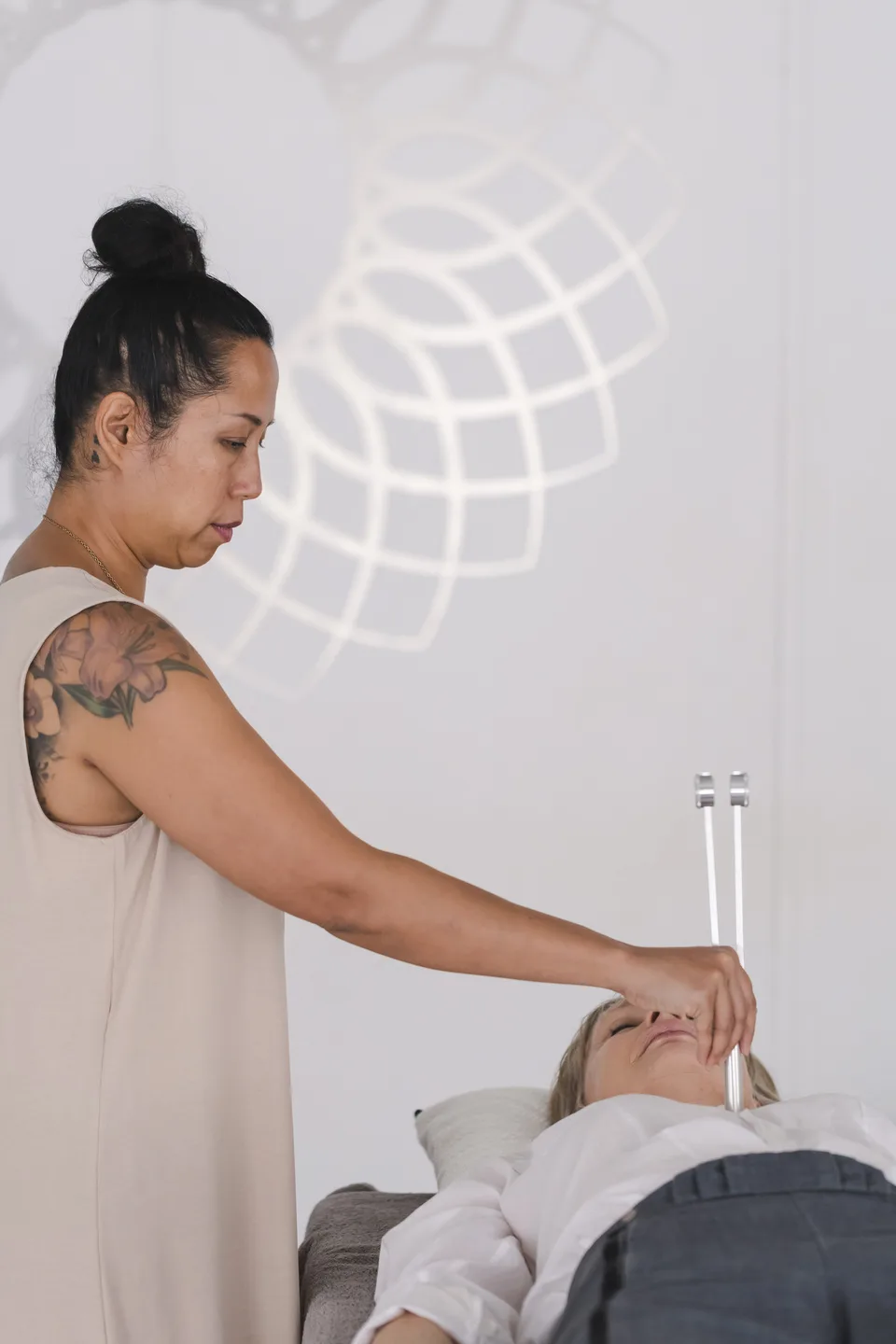
- Assessment through the biofield. The practitioner activates the forks and moves them through the field around the body, listening for where the tone changes. Specific areas of the field correspond to specific emotional and physical patterns — the mapping is part of the method.
- Working with what's found. When a pocket of tension is located, the fork is held in that position until the tone stabilises. This is where the release happens. Clients often recognise what's surfacing as it's found — an old grief, a held pattern, a memory the body's been carrying.
- Integration. The session closes with a period of stillness, allowing the system to integrate. Follow-up notes and any suggestions for between-session support are shared afterwards.
What it feels like
Most clients describe the experience as deep, almost trance-like relaxation. Tingling in the body. A sense of energy moving.
Sometimes emotional release as specific patterns surface. You don't need to do anything except receive — the work happens through the resonance of the forks and your field.
You may leave feeling lighter and more energised. Some people notice a period of adjustment — fatigue, heightened emotion, or a mild headache are not uncommon.
This is a natural part of any therapeutic process. When the system begins to release what it has been holding, there can be a temporary intensification before the settling.
Think of it less as a side effect and more as the body in motion — remembering what coherent, unobstructed flow feels like, and beginning to orient toward it. That orientation becomes the new baseline.
Learn more
Want a detailed breakdown of what happens in a session?
Each phase in detail — from the pre-session email to the 24 hours after. Useful if you're preparing for your first.
What to expectWhat it addresses.
Biofield Tuning doesn't diagnose or treat medical conditions. What it can do is support the body and nervous system in releasing held patterns — patterns that often underlie recurring symptoms.
Clients typically come for one of these reasons, or a combination of them:
- Recurring physical tension with no clear medical cause — chronic tightness, unexplained pain, body patterns that return even after other treatment
- Emotional patterns that won't shift — grief, anxiety, reactivity, or old patterns that remain out of reach despite talking therapy or other modalities
- Trauma patterns stored in the body — the things that talk therapy touches but doesn't fully release, because the body holds what the mind can't reach
- Nervous system dysregulation — chronic stress, difficulty dropping into rest, sleep issues, hypervigilance
- A sense of stagnation — stuck energy, creative blocks, a feeling that something's held without being able to name what
- Deepening a wellness practice — existing therapy, meditation, or bodywork practice that would benefit from direct work with the biofield
The work is not a substitute for medical care. It's a complement to it. Biofield Tuning is best thought of as working alongside other forms of support — not in place of them.
For the broader category context, see tuning fork healing. For the local sound healing landscape in Sydney, including group experiences and 1:1 work.

Research & evidence.
The research base for sound therapy and biofield work is still emerging. The links below point to peer-reviewed research that supports the underlying mechanisms — not claims about Biofield Tuning specifically.
Selected research
- HeartMath Institute — decades of research on the heart's electromagnetic field, heart-brain coherence, and the measurable effects of coherent emotional states on physiology. Visit HeartMath
- Frontiers in Psychology — multiple studies on sound-based interventions, binaural beat stimulation, and their effects on anxiety, mood, and autonomic nervous system function. Visit Frontiers
- Polyvagal theory — Dr Stephen Porges — foundational work on the vagus nerve, autonomic regulation, and how sound and breath influence nervous system state. Visit Polyvagal Institute
- Journal of Music Therapy — ongoing research on therapeutic applications of sound, vibration, and resonance in clinical and wellness settings. Visit Journal of Music Therapy
- NeuroImage — neuroimaging studies on how different sound frequencies affect brain activity, particularly in regions associated with emotional processing and memory. Visit NeuroImage
- Global Advances in Integrative Medicine and Health — integrative medicine research including biofield therapies, with several papers focused on the measurable effects of non-contact field-based interventions. Visit Global Advances
Biofield Tuning is a complementary practice. It is not a medical treatment and makes no medical claims. These references support the scientific plausibility of the mechanisms underlying the work — they are not specific endorsements of the Biofield Tuning method.