
What follows is the mechanism in three layers — how sound reaches the body, what the practitioner is actually doing, and what unfolds in the nervous system as the session lands. For the full overview of the modality, see Biofield Tuning.
How sound reaches the body.
Sound is physical. A tuning fork produces a sustained pressure wave at a specific frequency — along with its overtones and undertones, meaning multiple frequencies are introduced simultaneously.
That wave moves through air, through tissue, and through the field around the body. It isn't metaphor — it's mechanical force, calibrated and measurable.
The autonomic nervous system responds first. Before the cognitive mind processes "I'm hearing a sound," the autonomic nervous system has already shifted state. Heart rate variability adjusts. Breathing slows.
Vagal tone changes. This is well-established physiology — the same mechanism that makes certain sounds calming and others activating.
The vagus nerve is central. Sound and vibration directly influence vagal tone, which governs much of the parasympathetic (rest-and-digest) response. Nervous system research has been mapping this for decades. Tuning forks produce one of the most precise sound inputs available — a single, sustained, calibrated frequency rather than the layered complexity of music or speech.
Why the field matters. The body's electromagnetic field is real and measurable — the heart alone produces a measurable field detectable several feet from the body (HeartMath research has been documenting this since the 1990s).
Biofield Tuning works at this electromagnetic level by bringing the calibrated fork tone into the field, rather than only the audible-sound level. That distinction is what differentiates the method from broader sound or music therapies.

What the practitioner does.
Listening, not just striking. The practitioner's primary skill isn't producing the sound — it's hearing how the sound changes. As the fork moves through the field around the body, the tone shifts subtly.
Where the field is coherent, the tone rings clear. Where energy is held, the tone changes character — quicker decay, slight distortion, a thinning of the ring.
What that change reveals. The pattern of changes maps onto what's held — pockets of tension, areas where the field shows incoherence. Trained practitioners learn to read these patterns over years of clinical practice. The field tells the practitioner where the work is — and how to apply the next fork or sequence to support release.
The fork doesn't 'fix' anything — it offers a sustained, coherent input that the field can use to find its own coherence again.
What the research is showing.
What's well-established. Sound and vibration have demonstrable effects on the body — ultrasound is used diagnostically and therapeutically in mainstream medicine; focused sound waves are used to break up kidney stones; ECG and EEG measure the body's own electrical and acoustic activity.
At a systems level, acoustic input measurably shifts heart rate variability, vagal tone, and breathing patterns. Polyvagal theory and HeartMath Institute research provide the strongest grounding for what practitioners observe in sessions.
What's still emerging. Specific claims about which frequencies do what, or about the body's biofield as a discrete measurable phenomenon, are still being researched. Peer-reviewed research on the biofield concept has been published in journals like Global Advances in Health and Medicine since the 1990s. The mechanism is plausible and the practitioner observations are consistent — but this is still an emerging field. Honest framing matters.
A landmark 2026 study. Researchers at The University of Texas MD Anderson Cancer Center published findings in Cancer Medicine documenting the biological effects of biofield therapy on pancreatic cancer. In repeated mouse models, biofield therapy reduced cancer spread to the liver by more than 50% and significantly inhibited the proliferation of multiple cancer cell lines.
Researchers observed changes at a cellular level — including alterations in cell voltage potential and gene expression associated with cancer growth. Importantly, because the effects were observed in cell cultures and animal models, the results are independent of placebo.
Further large-scale human clinical trials are needed, but the study marks a significant moment for biofield research. Note: this study examined biofield therapy broadly — not Biofield Tuning specifically — but it points toward a growing body of evidence that the biofield is a legitimate site of biological influence.
A starting point, not an exhaustive map:
- HeartMath Institute — heart-brain coherence and acoustic resonance
- Stephen Porges — Polyvagal Theory — the science of nervous system safety and vagal tone
- Frontiers in Psychology — peer-reviewed work on sound, music therapy, nervous system regulation
- Global Advances in Health and Medicine — peer-reviewed work on the biofield concept
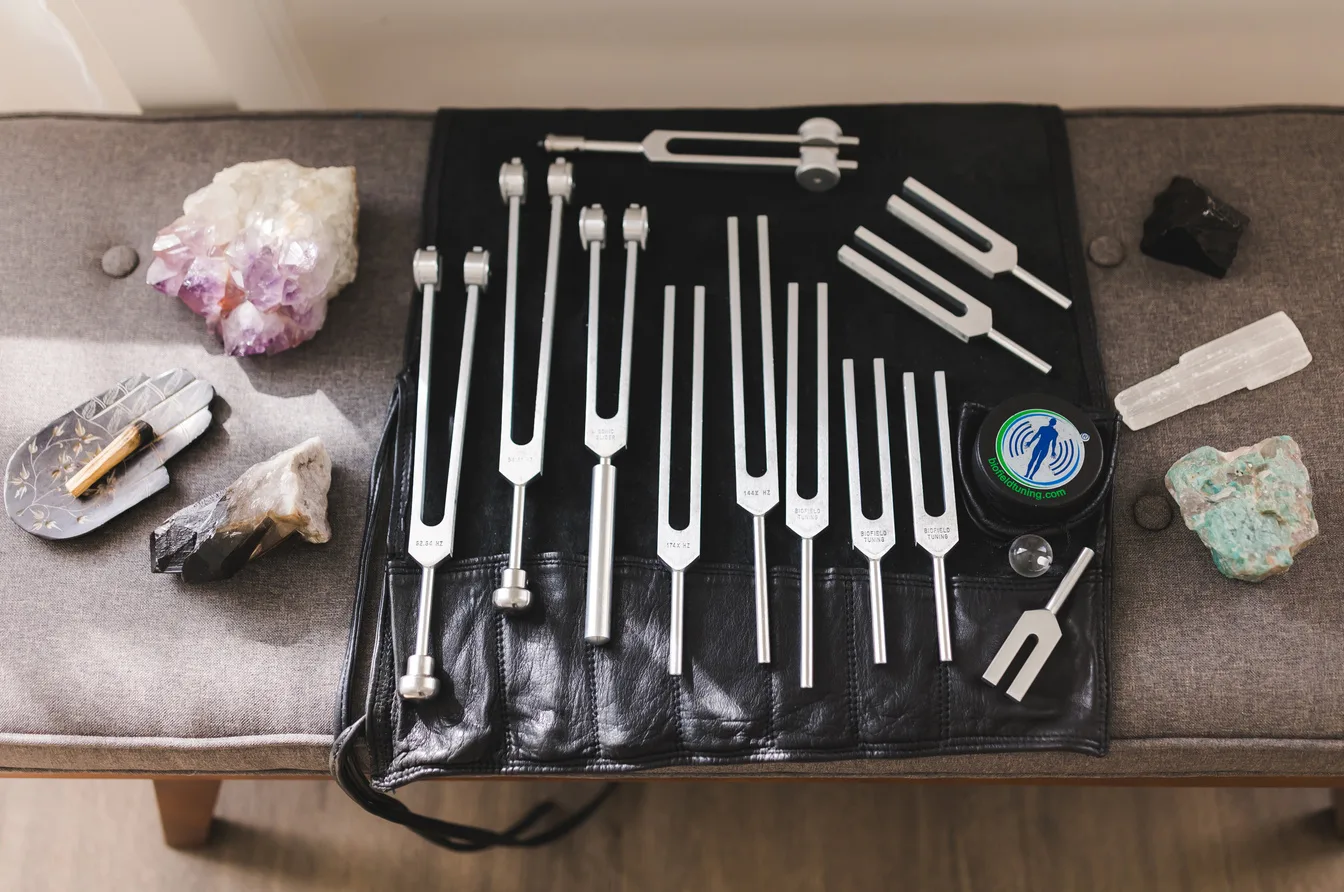
What specific frequencies do.
128 Hz. A common fork in clinical practice. 128Hz is octave-related to "concert C" and has been used in medical examination — the Weber and Rinne hearing tests — since the 19th century.
In therapeutic application, it's often used over the body for general grounding and parasympathetic engagement. A weighted 128Hz fork has a low frequency that produces a tactile vibration the body feels as well as hears.
The Solfeggio frequencies (174, 396, 432, 528 Hz, etc.). These are popular in the broader sound healing space, often associated with specific therapeutic claims. The peer-reviewed research supporting the specific claims (e.g. "528Hz repairs DNA") is thin. That said, many people who are sensitive to sound report a genuine range of somatic experiences when listening to solfeggio frequencies — and that lived experience is data worth taking seriously.
What matters more than the specific Hz. The quality of the fork and the capability of the practitioner carry more weight than any single frequency. What a trained practitioner brings is the ability to listen to what the field is communicating — to track where tone meets resistance, where something is held, and how to facilitate the release of that tension so the field can return to flow and coherence.
The specific frequency is one variable among many. What it's applied to, and by whom, is what determines the depth of the work.
Ready to experience it?
A session in Mona Vale or online
Calibrated tuning forks, one-on-one. 60 or 90 minutes, in person at Onespace Collective in Mona Vale or online from anywhere.
See sessions and bookWhy the work continues after the session.
The nervous system needs time to land. When tension is released from the field and the body experiences full flow and coherence, something shifts at a more fundamental level — a new energetic baseline begins to establish itself. Like any deeper integration, embodiment takes time.
But as coherence is maintained, something else begins to change too: what we carry into the world, what we project, and what we find ourselves drawing back. The field in flow doesn't just feel different. It operates differently.
For what that experience looks like from the client side, see what to expect.