
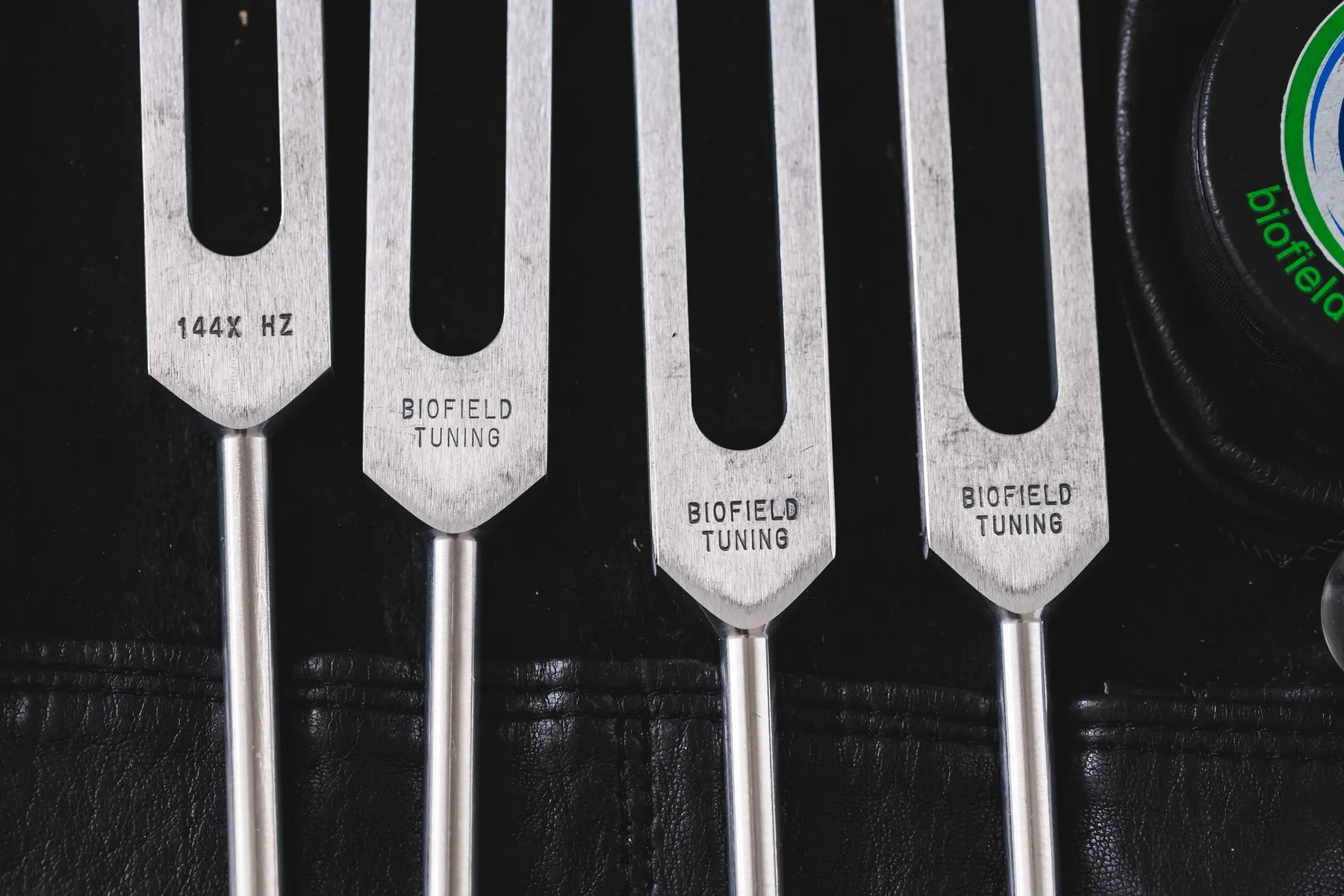
Your first fork.
If you're just starting, you don't need a set. Choose for the way you want to use it: weighted if you want to feel it on the body, unweighted if you want sound in the room or near your ear. If I had to pick one place to start, it would be the Schumann pair.
Frequency.
Every tuning fork is built to resonate at a specific frequency, measured in Hertz (Hz). Some are tuned to musical intervals. Others step outside the musical scale – the Solfeggio set follows a numerical sequence, while planetary and Schumann forks are calculated from astronomical or geophysical measurements.
None of these frequencies is more "correct" than another. They're tools for different purposes, shaped by intention.
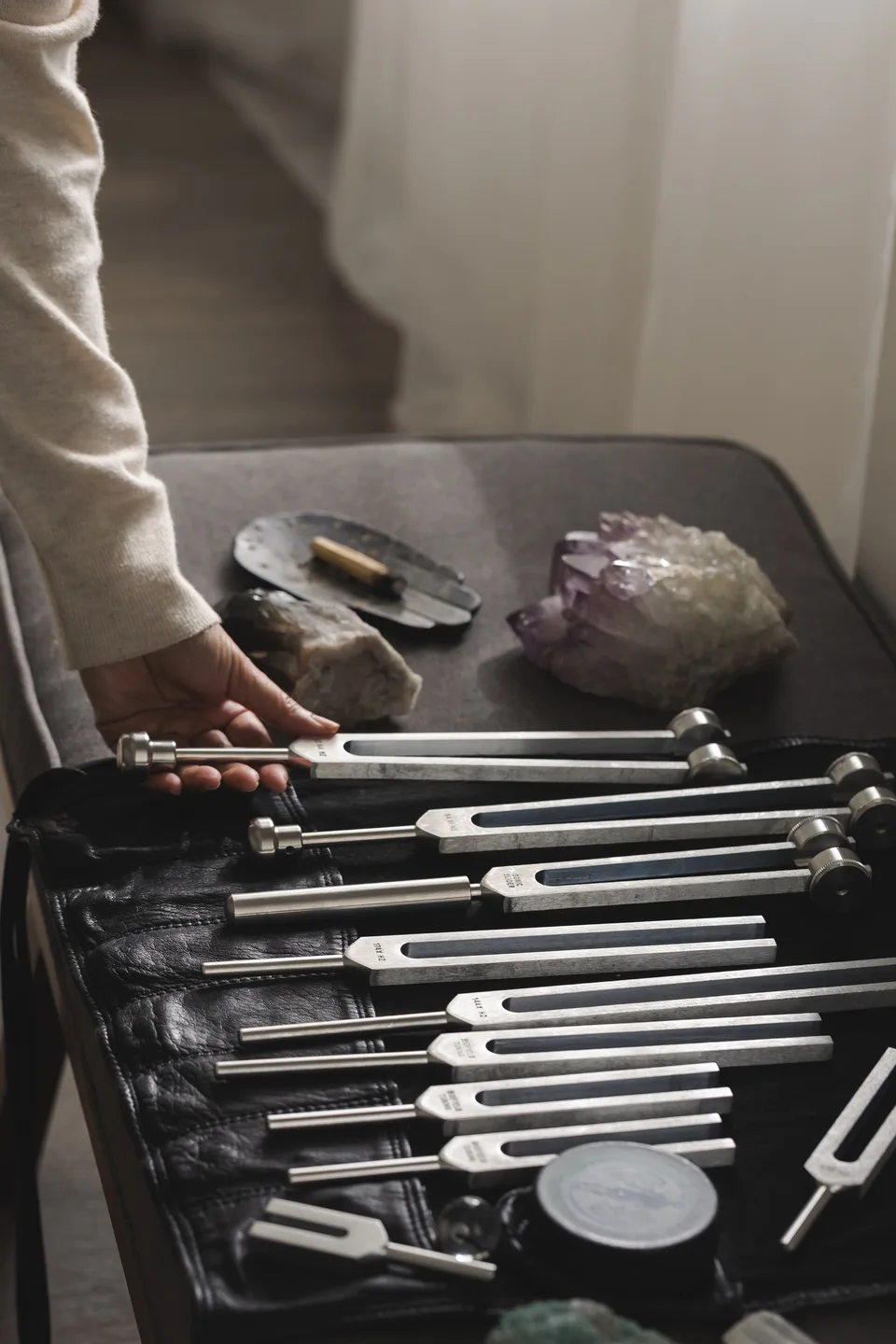
Before you buy, get clear on what you actually want a fork for: physical soothing, relaxation, a meditative state or a particular sound. Choose on that, rather than on which frequency sounds the most mystical in the product description.
Harmonics and overtones.
A tuning fork doesn't just produce one pure frequency – it creates a fundamental tone plus a series of harmonics and overtones above it. This is part of why forks feel so different from a plain sine-wave app: the overtone structure gives the sound its texture and shimmer.
Higher-quality forks tend to have cleaner, more consistent overtones. What matters is that they're stable and predictable, especially if you use a fork therapeutically and want the same experience session to session.
Materials and quality.
This is where price differences usually come from. Aluminium alloy is the standard for good reason: it's dense enough to hold a clean, accurate frequency and sustain a long, even tone. Cheaper forks, often made from thinner or lower-grade metal, tend to go flat quickly or produce a duller, shorter-lived tone.
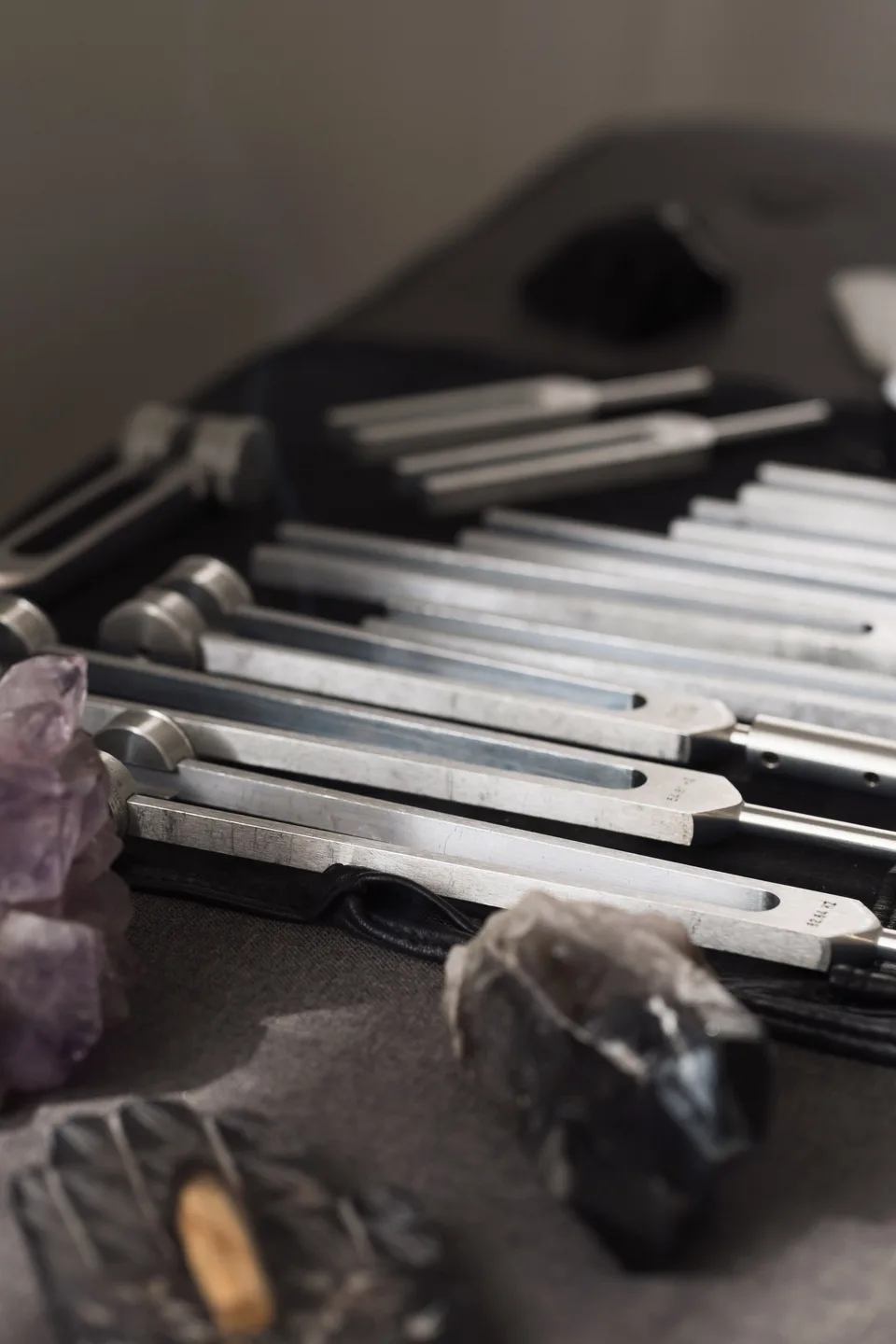
A well-made fork should feel substantial in the hand and hold its tune strike after strike. Beyond a certain price point, it should come with documentation of the frequency it's calibrated to. If a listing can't state the exact Hz, treat that as a red flag.
What forks cost.
A cheap 8–10 fork set from a marketplace runs about A$70–110. A good single fork from a specialist maker is about A$70–170, and a practitioner kit A$450–800. What the extra money buys is everything above: a stated, accurate frequency, a tone that holds, and metal that carries a fuller vibration.
Prices as of October 2026.
Weighted vs unweighted.
This is one of the most practical distinctions to understand.
- Unweighted forks are used primarily for sound: held near the ear, or used to fill a room with tone. They have a longer sustain and a brighter, more resonant sound.
- Weighted forks have added mass at the base of the tines (often small metal discs) and are designed for direct contact with the body. The added weight transfers vibration into tissue rather than just projecting sound into air. This is the version you want for placement on acupressure points, joints or areas of tension.
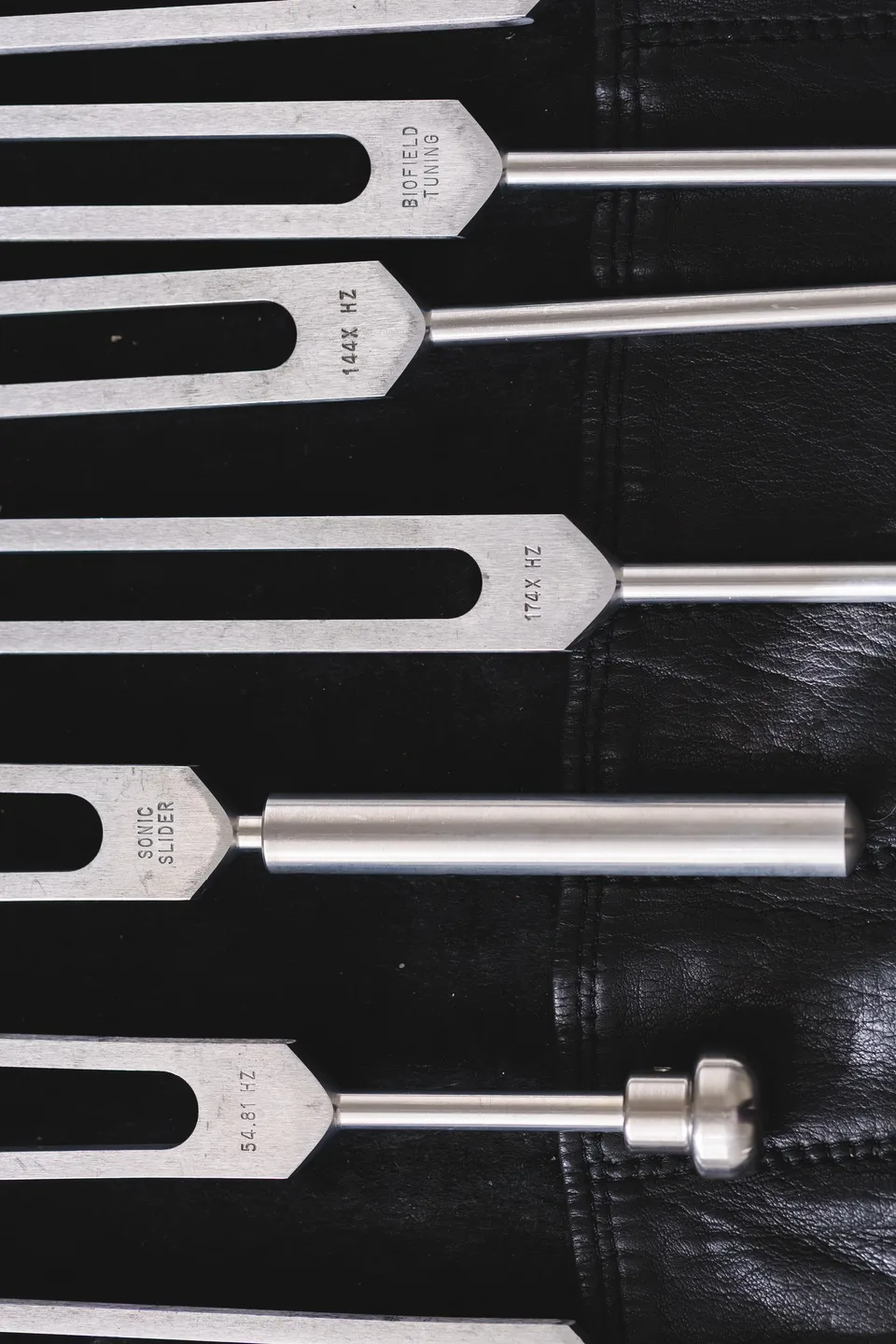
Some forks and frequencies simply have a nicer, longer-ringing sound – a sustain that feels good to sit inside, regardless of weighted or unweighted. But felt vibration – the somatic information your body picks up through touch or proximity – isn't exclusive to weighted forks. Unweighted forks held close to the body, or even near the ear, still transmit a felt sense; it's just a different quality of information than direct-contact work.
Material plays into both. Denser, higher-grade metal holds pitch better and carries a fuller, more textured vibration, which is part of why a well-made fork feels different against the skin (or in the room) than a cheap one, weighted or not.
If you're planning to work with forks on the body, choose weighted. If you're working primarily with sound in space, unweighted will serve you better.
My favourites.
The Schumann pair.
Activated on either side of the head, this Biofield Tuning pair creates a binaural beat of 7.83Hz, sitting right between alpha and theta states. There's a groundedness to working with a frequency tied to the planet's own electromagnetic field that I don't find in other forks.
The Elemental set.
Sonoki's Earth and Sun star forks create a monaural beat of their own (10Hz). They're less about a loud ring and more about a long-lasting vibration you feel rather than hear. I love ending a session with these, for an anchored, embodied close.
111Hz and 222Hz.
Gorgeous frequencies for meditation or sound healing. I create the 111Hz sound using either the combination of the 417Hz and 528Hz or the 528Hz and 639Hz. Absolutely lovely to listen to.
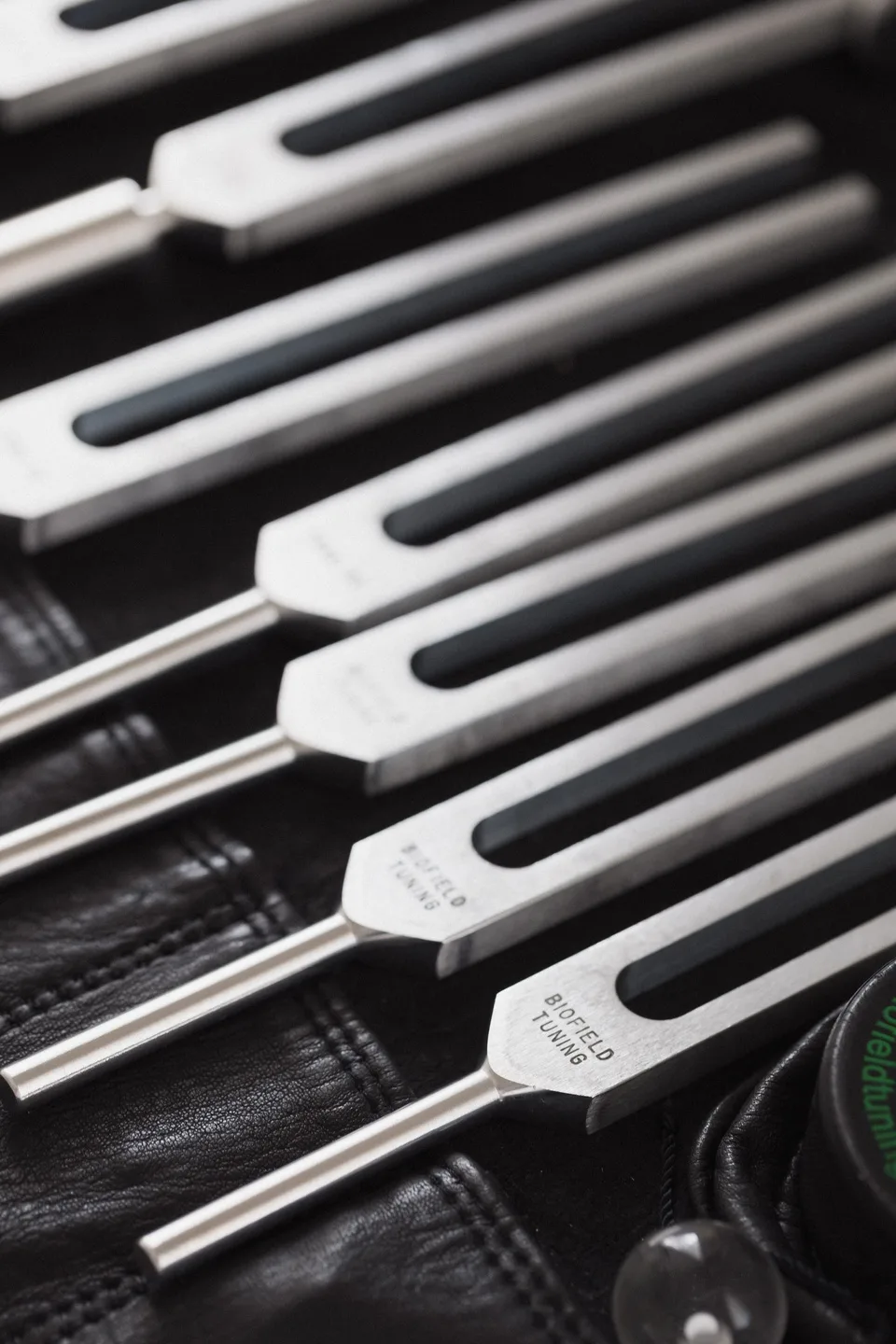
128Hz weighted forks.
I have one, though it's not a fork I reach for. It's a trendy fork, often marketed for pain relief. When I have worked with it, I've noticed it vibrates very strongly, so you feel it on the body without needing to apply pressure.
More on 128Hz in how Biofield Tuning works.
The Sonic Slider.
A Biofield Tuning fork, and my go-to for lymphatic drainage and what I call tuning fork first aid. I also use it to sculpt, gliding it over the body.
The Tesla Trio.
That's my affectionate name for the 396, 639 and 963Hz forks from Sonoki and SWB. I use them together to set an intention of connecting the sacral, throat and crown chakras. They create an amazing monaural beat when struck together.
My fork picks, at a glance.
| Fork | Frequency | Weighted? | What I use it for |
|---|---|---|---|
| The Schumann pair Biofield Tuning | 54.81 + 62.64Hz – a 7.83Hz beat | Weighted | Focus and relaxation |
| The Elemental set Sonoki | Earth 136.1 + Sun 126.22Hz – a 10Hz beat | Unweighted | Closing a session – felt more than heard |
| 111Hz and 222Hz | 111Hz from 417 + 528 or 528 + 639 | Unweighted | Meditation, sound healing |
| 128Hz | 128Hz | Weighted | Strong felt vibration on the body |
| The Sonic Slider Biofield Tuning | 93.96Hz – the 12th harmonic of the Schumann resonance | Weighted | Lymphatic drainage, sculpting |
| The Tesla Trio Sonoki, SWB | 396, 639, 963Hz | Unweighted | Setting an intention |
Vanessa Fernandez's tuning fork picks · biofieldtuning.com.au
Accessories.
A hockey puck or silicone weight.
A rubber hockey puck or a 5 lb double-ended silicone weight. Either gives a better strike than a mallet, and saves your hands and body when you're striking a weighted fork over and over. You can get one from Biofield Tuning, Sonoki or a sporting goods store!
The Slender Extender.
From Biofield Tuning, and this one does double duty: use it like a gua sha tool – excellent for lymphatic drainage – and the bottom end works well for acupressure.
The Obsidian Gem Boot.
Sonoki's fork boot, made from obsidian, a natural volcanic glass with little or no crystal structure. Obsidian is regarded as one of the strongest grounding and protective stones, and it was used for some of the sharpest cutting tools in the ancient world.
Housed around a weighted fork, it means every point of contact carries the fork's vibration, grounded in obsidian. I pair it with my Sonic Slider, which is tuned to the 12th harmonic of the Schumann resonance. It makes for a powerful, earthy combination.
A fork for each intention.
- Tight, tense muscles: 128Hz (weighted)
- Sculpting and lymphatic drainage: Sonic Slider
- Meditation or sound healing: 222Hz, 528Hz, 963Hz
- Focus and relaxation: the Schumann pair
Trust your own resonance.
I've shared my favourites, but I encourage you to explore, experiment and trust your own judgement. Ultimately the right fork comes down to what resonates for you, so stay open and follow how it feels in your own body.
Happy forking!
If you're drawn to work with sound and voice yourself, my Sound Healing Basics ebook is a gentle place to start. My vocal toning and embodiment workshops are at Stellar Sound.